 info@businessghana.com



During this women’s month we continue to reflect on women’s rights, participation, and leadership.
Last week, we examined How can African women emerge as successful leaders across politics, corporate governance, business, and entrepreneurship, and what structural reforms are required to make their leadership the norm rather than the exception?
Africa stands at a pivotal moment. The implementation of the African Continental Free Trade Area (AfCFTA) represents one of the most ambitious economic integration projects in the world. With a potential market of over 1.3 billion people, AfCFTA offers unprecedented opportunities for industrialisation, intra-African trade, and regional value chains.
Yet, the success of this continental project will depend largely on whether women, who constitute a significant share of Africa’s entrepreneurs, agricultural producers, and informal cross-border traders, are meaningfully integrated into the new economic architecture.
Across the continent:
Women account for the majority of informal cross-border traders
Women dominate micro and small enterprise sectors
Yet they remain largely excluded from formal trade systems, finance, and industrial value chains
This episode therefore examines women not only as entrepreneurs, but as strategic actors in Africa’s economic future.
This debate explores a critical geopolitical question:
Can economic inclusion of women become a stabilising force for Africa—reducing inequality, strengthening regional economies, and contributing to long-term peace and stability?
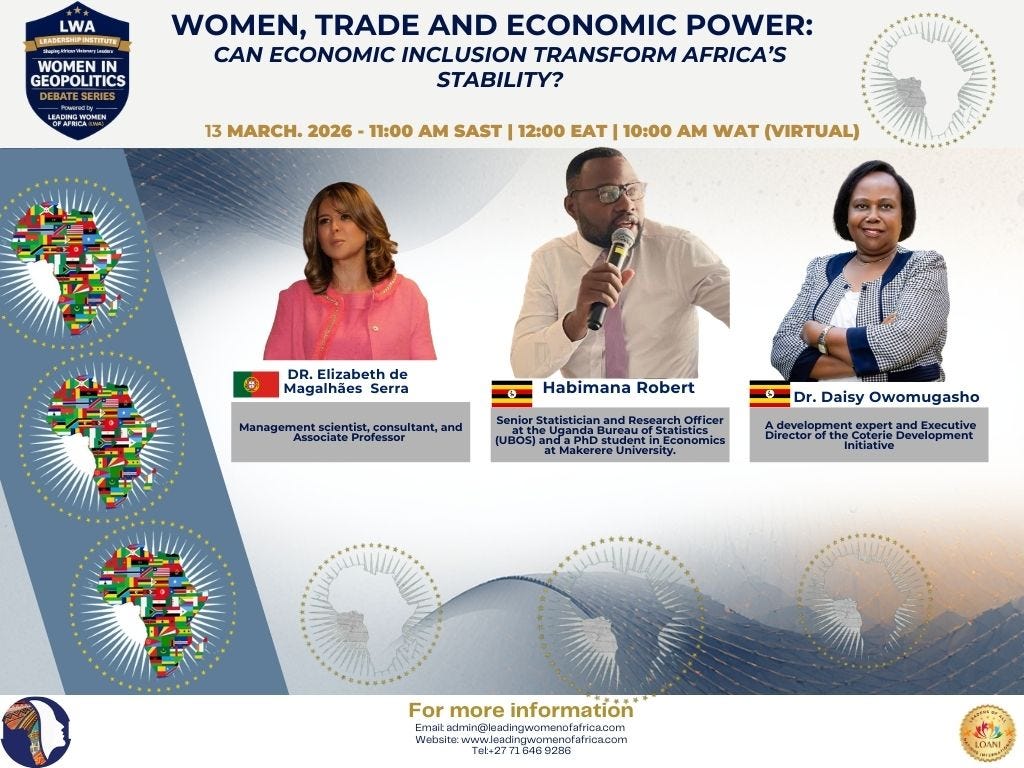
Join us this Friday for Episode 10 of the Women in Geopolitics Debates as we explore how women traders, entrepreneurs, policymakers, and financial institutions can work together to unlock Africa’s economic potential, and whether economic inclusion can become a pathway to greater stability across the continent.


